

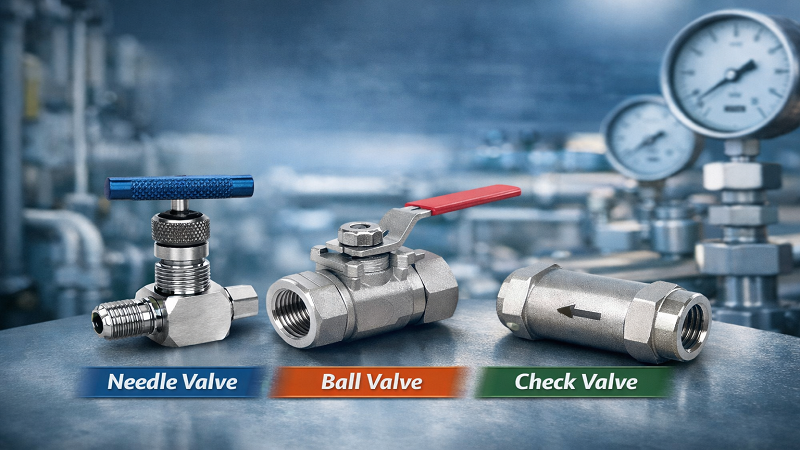
How to Choose the Right Instrumentation Valve: Needle, Ball & Check
Selecting the right instrumentation valve is critical for ensuring safety, accuracy, and long-term performance in industrial systems. Among the most commonly used valves are needle valves, ball valves, and check valves—each designed for a specific function. Understanding their differences, advantages, and ideal applications helps engineers and buyers make informed decisions. In this guide, we’ll compare needle vs. ball vs. check valves, explain how each works, and help you choose the right instrumentation valve for your process.
What Is an Instrumentation Valve?
Instrumentation valves are precision-engineered valves used to control, isolate, regulate, or direct the flow of fluids and gases in industrial processes. They are widely used in industries such as:
- • Oil & Gas
- • Chemical & Petrochemical
- • Power Generation
- • Pharmaceuticals
- • Food & Beverage
- • Water & Wastewater Treatment
Choosing the correct valve type ensures accurate flow control, reduced leakage, and improved system reliability.
Needle Valves: Precision Flow Control
What Is a Needle Valve?
A needle valve is designed for fine and precise flow regulation. It features a long, tapered needle-like plunger that fits into a small orifice, allowing gradual adjustment of flow.
Key Features of Needle Valves
- • Excellent throttling capability
- • Precise flow adjustment
- • Compact and robust design
- • Suitable for low flow applications
Common Applications
- • Instrumentation lines
- • Pressure gauges
- • Sampling systems
- • Hydraulic and pneumatic systems
Advantages
- • Highly accurate flow control
- • Ideal for low flow and high-pressure systems
- • Minimizes flow shock
Ball Valves: Quick Shut-Off and Isolation
What Is a Ball Valve?
A ball valve uses a rotating spherical ball with a bore to control flow. A 90-degree turn of the handle allows the valve to fully open or close, making it ideal for quick isolation.
Key Features of Ball Valves
- • Quarter-turn operation
- • Tight sealing capability
- • Simple and durable construction
Common Applications
- • Process isolation
- • Fuel and gas systems
- • Chemical pipelines
- • Water and air services
Advantages
- • Fast open and close operation
- • Low pressure drop
- • Reliable sealing with minimal leakage
Check Valves: Preventing Backflow
What Is a Check Valve?
A check valve is an automatic valve that allows flow in only one direction and prevents reverse flow. It operates without manual intervention.
Key Features of Check Valves
- • Automatic operation
- • Protects equipment from backflow
- • Available in multiple designs (spring-loaded, swing, lift)
Common Applications
- • Pumps and compressors
- • Pipeline systems
- • Chemical processing units
- • Water supply systems
Advantages
- • Prevents system damage
- • No external control required
- • Improves system safety
| Feature | Needle Valve | Ball Valve | Check Valve |
|---|---|---|---|
| Primary Function | Flow regulation | On/off isolation | Prevent backflow |
| Operation | Multi-turn | Quarter-turn | Automatic |
| Flow Control | Excellent | Limited | None |
| Speed | Slow | Fast | Automatic |
| Best For | Precision control | Quick shut-off | System protection |
How to Choose the Right Instrumentation Valve
When selecting the right valve, consider the following factors:
1. Application Requirement
- • Precise control → Needle valve
- • Quick isolation → Ball valve
- • Backflow prevention → Check valve
2. Pressure and Temperature
Ensure the valve material and design can handle system pressure and operating temperature.
3. Media Type
Consider whether the fluid is corrosive, viscous, or contains particles.
4. Installation Space
Compact systems may require smaller or inline valve designs.
5. Industry Standards
Ensure compliance with relevant standards such as API, ASTM, or ISO.
Common Mistakes to Avoid
- • Using ball valves for precise throttling
- • Installing check valves in the wrong orientation
- • Ignoring pressure and temperature ratings
- • Selecting incorrect materials for corrosive media
Avoiding these mistakes can significantly improve valve performance and lifespan.
Final Thoughts
Choosing the right instrumentation valve—whether needle, ball, or check—depends on your specific application needs. Needle valves offer precision, ball valves provide quick and reliable isolation, and check valves ensure system safety by preventing backflow. By understanding their differences and proper use cases, you can enhance operational efficiency, reduce maintenance costs, and ensure long-term reliability of your instrumentation system.
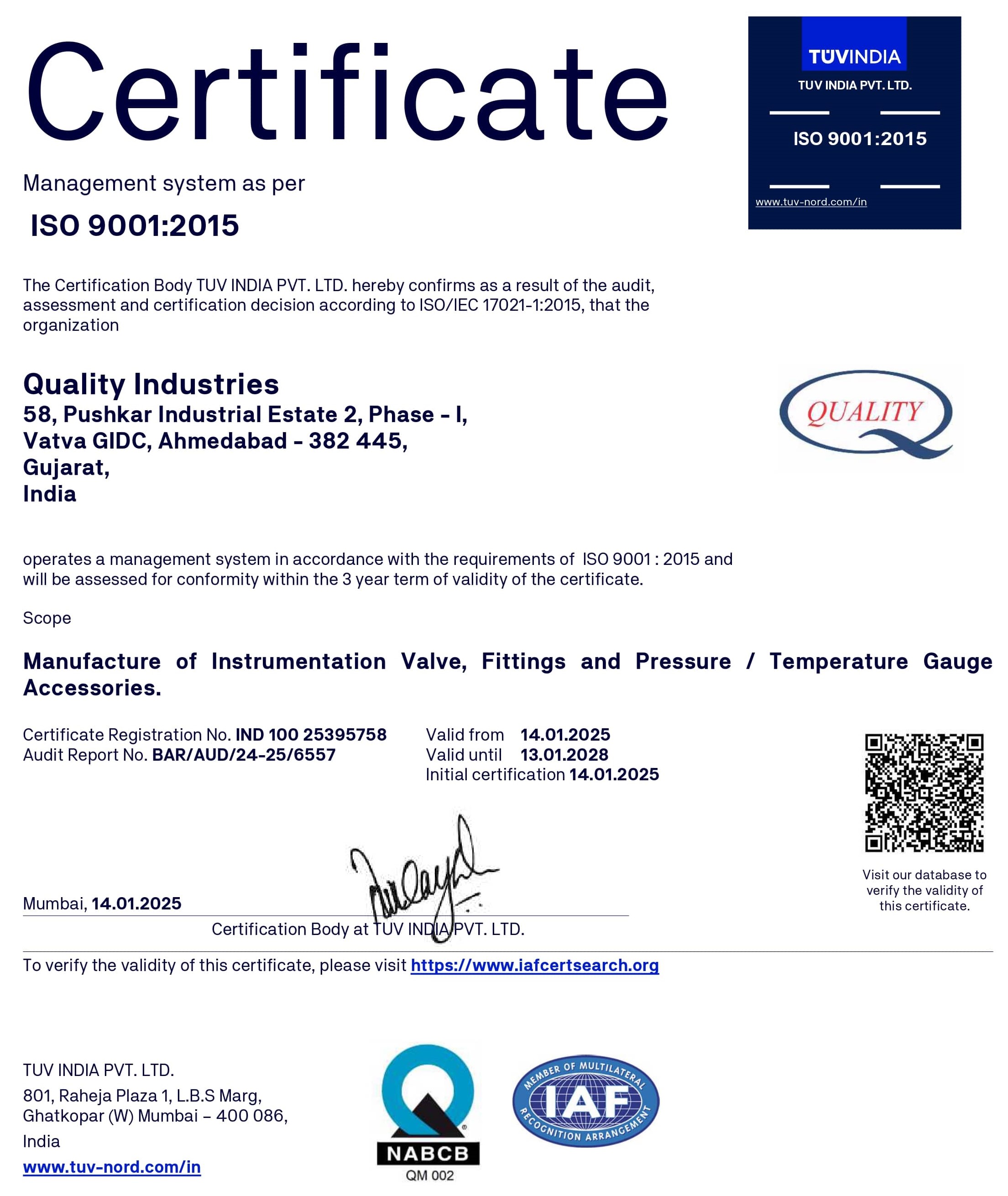

The company started on a very small scale in 2011 and now has the latest manufacturing and testing facility. The company is located in Gujarat, in the western part of India.